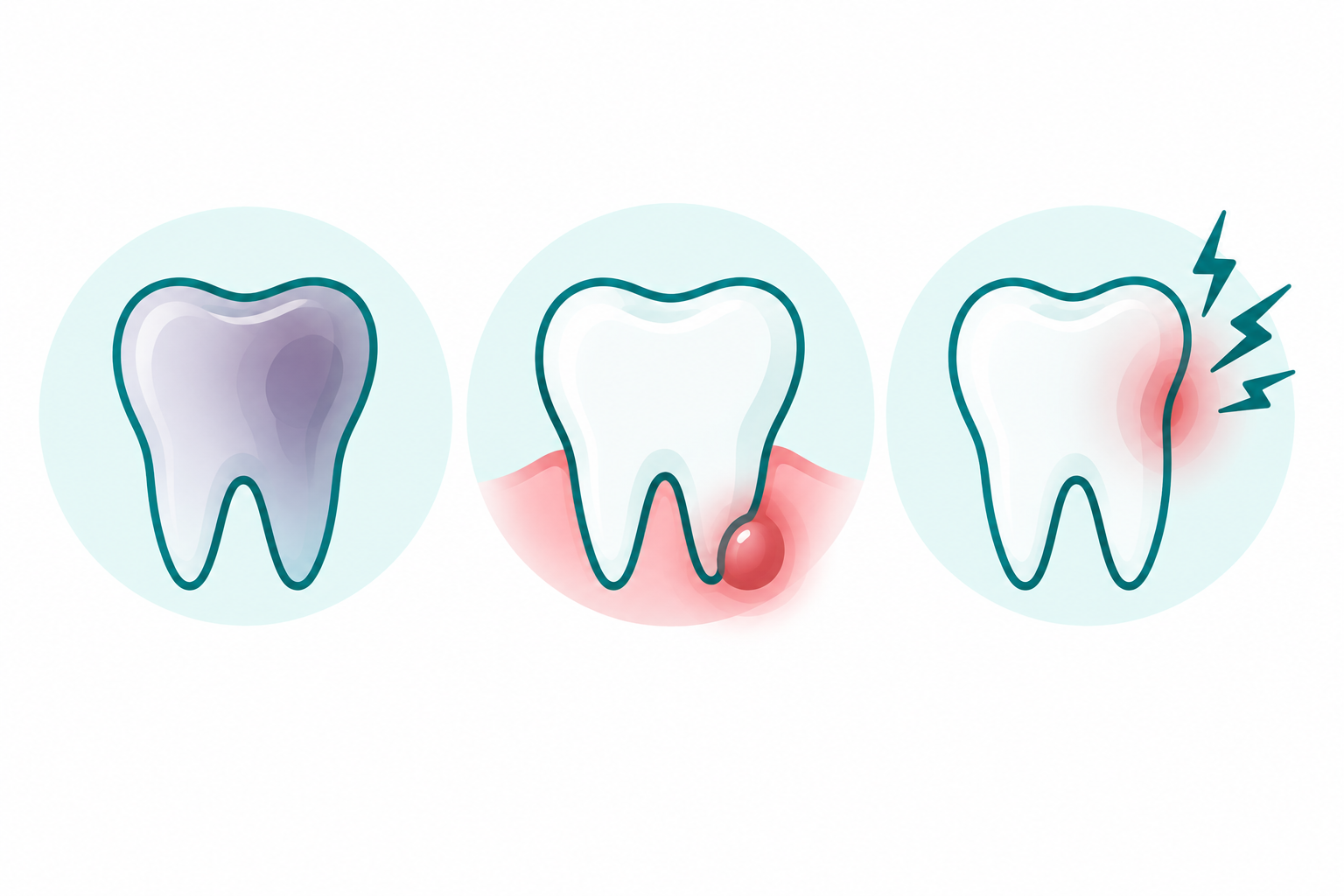
What to Do if a Tooth Is Chipped or Broken

A chipped or broken tooth after a fall or blow isn’t usually as time-critical as a knocked-out tooth, but it should still be assessed by a dentist. Some chips are minor; others expose the nerve or weaken the tooth enough to need urgent treatment. If the tooth has come out completely, see what to do if a permanent tooth is knocked out instead — this guide is for teeth still in place but chipped or fractured.

How urgent is this?

See a dentist urgently (same day, or emergency line) if:

  • There’s significant pain, especially sensitivity to hot, cold or air
  • Part of the tooth’s pink or reddish centre is visible — this can mean the nerve is exposed
  • A large piece has broken off, or most of the tooth is missing
  • The tooth has also moved or changed position, not just chipped — see what to do if a tooth is pushed in, out or sideways
  • The break happened alongside other injuries — see dentist, NHS 111, A&E or 999

Book a routine or next-available appointment if:

  • It’s a small chip, with a rough edge but no pain
  • There’s no visible pink or red centre
  • The tooth doesn’t feel loose or sensitive, and hasn’t moved

If you’re at all unsure which category this falls into, treat it as urgent — a dentist can quickly confirm it’s minor, but exposed nerve tissue left untreated can lead to infection.
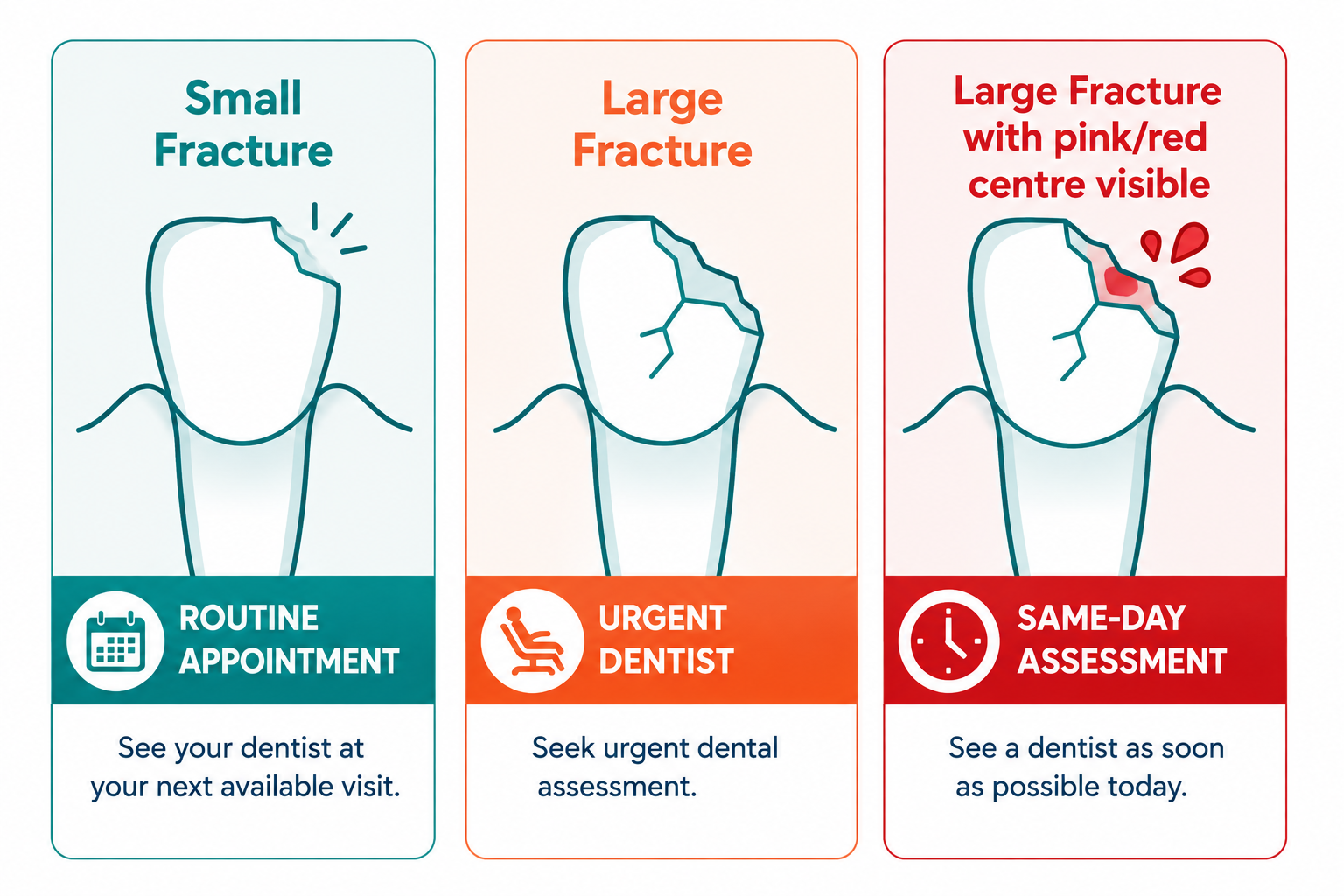
Simple three-tier classification: small chip - routine appointment; large fracture - urgent dentist; pink or red centre visible - same-day assessment

What to do right now

  1. Find any broken pieces if you can, and keep them. In some cases, the original fragment can be bonded back onto the tooth, giving the most natural appearance — but this only works if it’s brought to the appointment.
  2. Rinse the mouth gently with warm water to clear any blood or debris.
  3. Cover a sharp edge if it’s cutting the tongue, cheek or lip. Dental wax, if you have it, works well as a temporary cover — sugar-free chewing gum is a reasonable alternative if you don’t.
  4. Apply a cold compress to the face, near the site, if there’s swelling.
  5. Use pain relief suitable for the person’s age, following the instructions on the packaging.
  6. Avoid biting on the tooth — stick to soft foods and chew on the other side until it’s been checked.
  7. Contact a dentist to arrange an appointment, using the urgency guide above to decide how quickly.

Do not do these things

  • Don’t ignore a chip just because there’s no pain — the nerve can still be affected without obvious symptoms straight away.
  • Don’t use household glue or anything not intended for dental use to try to fix it yourself.
  • Don’t throw away a broken piece — bring it to the appointment.
  • Don’t bite down deliberately to “test” the tooth.

What if…?

There’s no pain at all — does it still need a dentist?
Yes, even a painless chip should be checked. The absence of pain doesn’t rule out damage that could worsen later, and a dentist can assess this quickly.

The tooth feels rough but I can’t see any damage.
Rough or sharp edges are still worth having checked, especially if they’re catching on the tongue or cheek — smoothing or bonding is a straightforward fix.

Can a chipped tooth be fixed?
Yes — see “What the dentist may do” below for how this usually works, depending on the size of the chip.

What if the tooth is broken below the gum line?
This is more serious than a straightforward chip and needs urgent dental assessment — it can affect the tooth’s root and may not be obvious just by looking. Treat this as urgent, even without significant pain.

Is this the same as a loose tooth?
Not necessarily — a tooth can be chipped without being loose, or loose without being chipped. If the tooth also feels wobbly or out of position, see what to do if a tooth becomes loose after an injury.

What the dentist may do

For a small chip, the dentist may simply smooth the edge or use a tooth-coloured filling material to rebuild the shape in a single visit. For a larger break, especially where the nerve may be affected, treatment can range from a bonded restoration to root canal treatment, depending on how much of the tooth is involved. If a broken piece was kept and is undamaged, it may sometimes be reattached.

When should you contact the dentist again?

Most chipped or broken teeth heal without further problems, but the injury can occasionally affect the nerve inside the tooth even when things seemed fine at first. Get the tooth checked again if you notice, in the weeks or months afterwards:

  • The tooth turning grey, yellow or darker than the teeth next to it
  • A swelling or small boil on the gum near the tooth
  • Pain returning after it had settled down
  • New sensitivity that wasn’t there before

These can be signs that the tooth’s nerve has been affected and needs further treatment — this is easily missed because it doesn’t always happen straight away.

If this happens at school, nursery or a club

The main task is finding and keeping any broken pieces, covering a sharp edge if needed, and arranging a dental appointment through the usual routes — this rarely needs 999 or A&E on its own. See Dental Trauma First Aid for Schools and Dental Trauma First Aid for Sports Coaches.

Related guides

Print this before you need it

Download the free Knocked-Out Tooth Poster to keep in your first aid room, sports bag or at home. Download free

References

  • International Association of Dental Traumatology (IADT), Guidelines for the Management of Traumatic Dental Injuries: Fractures and Luxations, 2020 (current as of August 2026)
  • NHS, Broken or chipped tooth, nhs.uk

This guide does not replace assessment by a dentist or emergency service. It reflects current international and UK guidance, reviewed by Dr Yousuf Ibrahim, BDS.
Related Guides

Sports coach checking a player's mouth after a dental injury on the pitch

Dental Trauma First Aid for Sports Coaches

Teacher providing first aid to a pupil after a dental injury at school

Dental Trauma First Aid for Schools

Parent comforting a child after a dental injury at home

A Parent’s Guide to Dental Injuries in Children

Dentist examining a tooth that has been pushed out of position after an injury

What to Do if a Tooth Is Pushed In, Out or Sideways

Person gently checking a tooth that has become loose after an injury

What to Do if a Tooth Becomes Loose After an Injury

Close-up of a person checking a chipped or broken tooth after an injury

What to Do if a Tooth Is Chipped or Broken

Compact teal ToothRevive dental trauma kit pouch with logo against a black background.

Be prepared for the dental emergency nobody expects.

The first few minutes can make all the difference.
Our Dental Trauma Kit contains everything you need to act fast and protect a knocked-out tooth.

Almost There!

Enter your email to unlock this free resource.

Download PDF Form