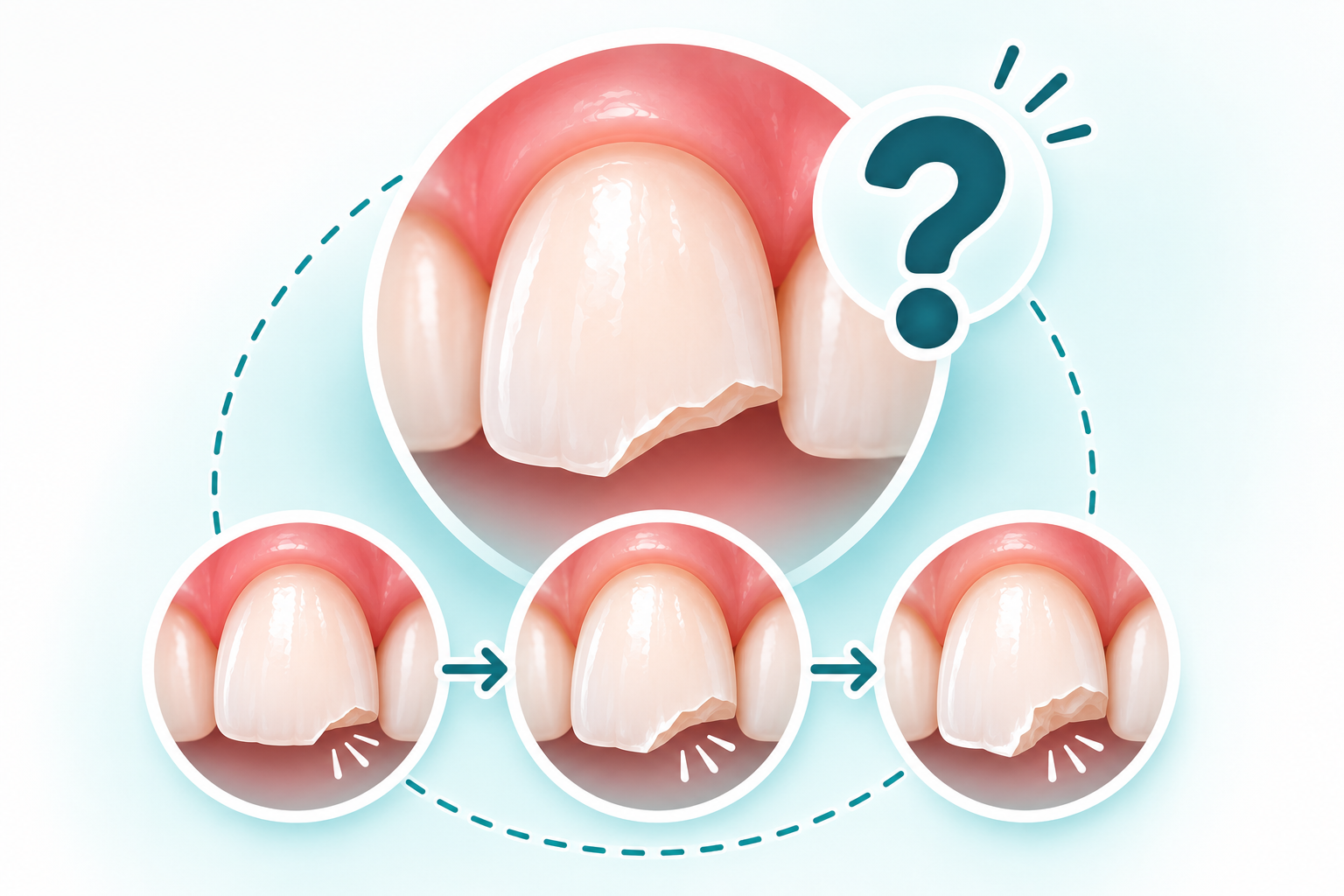
Most broken teeth are repaired with the simplest option that is likely to work, and many last well. If your chipped tooth keeps breaking, the useful question is why. The cause is often something that can be found and addressed, and a different type of repair is only sometimes part of the answer.
If the tooth has only just broken, start with what to do if a tooth is chipped or broken. This page is about what comes after.
A dentist’s first aims are to protect the tooth and keep the nerve (the pulp) healthy. After that, they choose the least involved repair that is likely to last. More involved does not mean better. Removing more of a tooth to fit a stronger-looking repair can weaken the tooth in the long run.
These are the options dentists commonly consider.
| Option | What it involves | Often considered when | Things to know |
|---|---|---|---|
| Smoothing and polishing | Rough edges are gently smoothed | A very small chip with no nerve involvement | Removes a small amount of enamel to smooth the edge. Only suits tiny chips |
| Reattaching the fragment | The broken piece is bonded back on | You have the piece and it fits well | Can look very natural, but may come off again under heavy biting |
| Composite (tooth-coloured filling or bonding) | Tooth-coloured material is built up and shaped | Small to medium breaks | Usually needs little or no drilling and can be repaired or added to later |
| Treating the nerve | Protecting an exposed nerve, sometimes removing only the exposed part (pulp capping or partial pulpotomy), or full root canal treatment | The break has reached the nerve | Dentists try to keep the nerve alive where possible. Root canal treatment is usually reserved for when the nerve cannot be saved or is infected |
| Veneer, crown or rebuild | A thin shell over the front, a cap over the whole tooth, or a larger rebuild when little tooth is left | A large part of the tooth is missing, cracked or badly weakened, or simpler repairs keep failing | These involve shaping or removing more of the tooth, so they are chosen only when needed. They can chip or wear too |
Your dentist will explain which of these suit your tooth. The right answer depends on how much tooth is left, where the break is, how you bite, and your age.
A child’s permanent tooth is still developing, so treatment often looks different from an adult’s.
A repair that needs attention during childhood is common and does not mean it was done badly. It is often part of the plan.
Whether it is bonding that keeps chipping off or the tooth breaking again beside the repair, there is usually more than one reason. Studies of front-tooth composite repairs find that fracture is the most common cause of failure, and that it depends on a mix of factors, not on the material alone. These are the most common ones.
1. How much healthy tooth is left.
Bonding works best when there is plenty of healthy tooth to grip. When a large piece is missing, the repair has less to hold onto and carries more of the bite.
2. Where the repair sits and how the teeth meet.
A biting edge takes force every time you close your teeth. If you bite edge to edge, have a deep bite, or your teeth meet unevenly, that edge takes extra stress.
3. Clenching or grinding.
Grinding, often at night, loads teeth and repairs far more than normal chewing, and research links it with more fractured repairs. Many people do not know they do it. Flat, worn edges and a sore jaw in the morning are common clues.
4. Habits.
Small, repeated knocks add up. See the next section.
5. Decay, cracks and enamel defects.
Decay beneath a repair, a hidden crack, or weaker enamel can all make a repair fail. Weaker enamel can come from a developmental enamel condition such as molar incisor hypomineralisation (MIH), or from wear and acid erosion. It is one possible cause, not the usual one.
6. Loss of tooth structure after previous treatment.
A tooth that has had a large filling or root canal treatment may have lost much of its structure and can be more fragile. What it needs depends on the tooth. A back tooth in this position often benefits from a crown or similar cover, while a front tooth with plenty of structure left may not need one.
7. How the repair was designed and bonded.
Bonding conditions, technique and the shape of the repair all play a part. Each time a repair is replaced, a little more tooth may also be lost, which is one more reason to look for the cause instead of repeating the same repair.
Dentists are often asked “why does it keep breaking?”, and habits are one of the most useful things to look at honestly when a chipped tooth keeps breaking. Common ones include:
Children often do these without noticing. Gentle reminders work better than telling them off, and a coach can help if sport is involved. See Dental Trauma First Aid for Sports Coaches for how mouthguards fit in.
Teeth that stick out are also more likely to be knocked and broken. If your child has prominent front teeth, mention it at a dental check, because an orthodontic (braces) opinion may be worth having.
A simple repair is usually a sensible first step. If a chipped tooth keeps breaking, the next step is not automatically a bigger repair. It is a closer look at the cause. A dentist will usually consider:
Sometimes the answer is a different type of repair, such as a veneer, a crown, or a larger rebuild. That tends to be more likely when a large part of the tooth is missing, the tooth is cracked or heavily worn, or little healthy tooth remains. Sometimes the answer is the same type of repair done differently, plus a mouthguard or night guard to protect it. Fixing the cause matters as much as fixing the tooth.
A few details make it much easier for a dentist to work out why a chipped tooth keeps breaking:
Your dentist will talk you through the options and what is most likely to last. If anything in the plan is unclear, it is always fine to ask them to explain it again.
Can I leave a chipped tooth alone?
A very small chip with no pain may only need smoothing, but it should still be checked. A dentist can tell whether the nerve or a deeper crack is involved.
Does a root canal make a tooth stronger?
No. Root canal treatment deals with the nerve. Whether a root-filled tooth needs a crown depends on the tooth and on how much healthy structure remains.
What is a post, and does it make a tooth stronger?
A post is a small pin placed in a tooth that has already had root canal treatment, when there is too little tooth left to hold a rebuild. It helps keep the rebuilt part in place. Its purpose is to hold the rebuild, not to strengthen the tooth.
Does a crown last forever?
No. Crowns and veneers can last many years when cared for, but they can chip, wear or need replacing. A mouthguard or night guard helps protect them.
Does a repair that keeps breaking mean it was done badly?
Not necessarily. Many repairs fail because of bite forces, habits or how much tooth is left. A dentist can reassess the repair’s design and bonding, alongside your bite and the remaining tooth.
Could the tooth still be damaged inside?
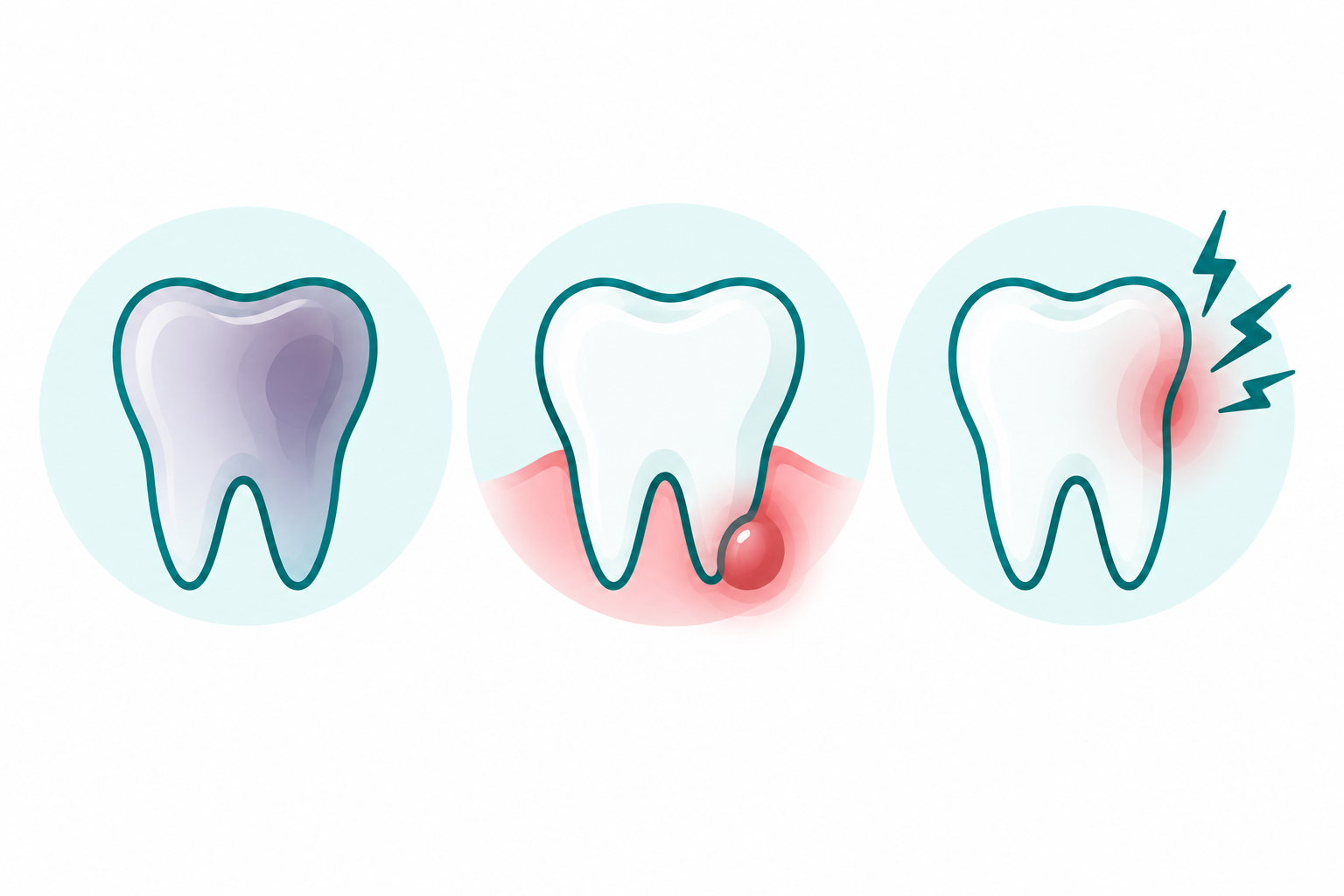
It can be. Watch for colour change, swelling or a gum boil, pain, or sensitivity that appears weeks or months later. See warning signs after a dental injury.
This guide does not replace assessment by a dentist. It reflects current clinical guidance and research, reviewed by Dr Yousuf Ibrahim, BDS.
About the author
General Dental Practitioner and Founder of ToothRevive
Published on dentistry.co.uk: “Dental trauma is a first aid problem, not just a dental one”, 7 October 2026.
The first few minutes can make all the difference.
Our Dental Trauma Kit contains everything you need to act fast and protect a knocked-out tooth.
Enter your email to unlock this free resource.
Clinically verified
Written by Dr Yousuf Ibrahim, a UK-registered dentist, in line with current dental trauma clinical guidelines.